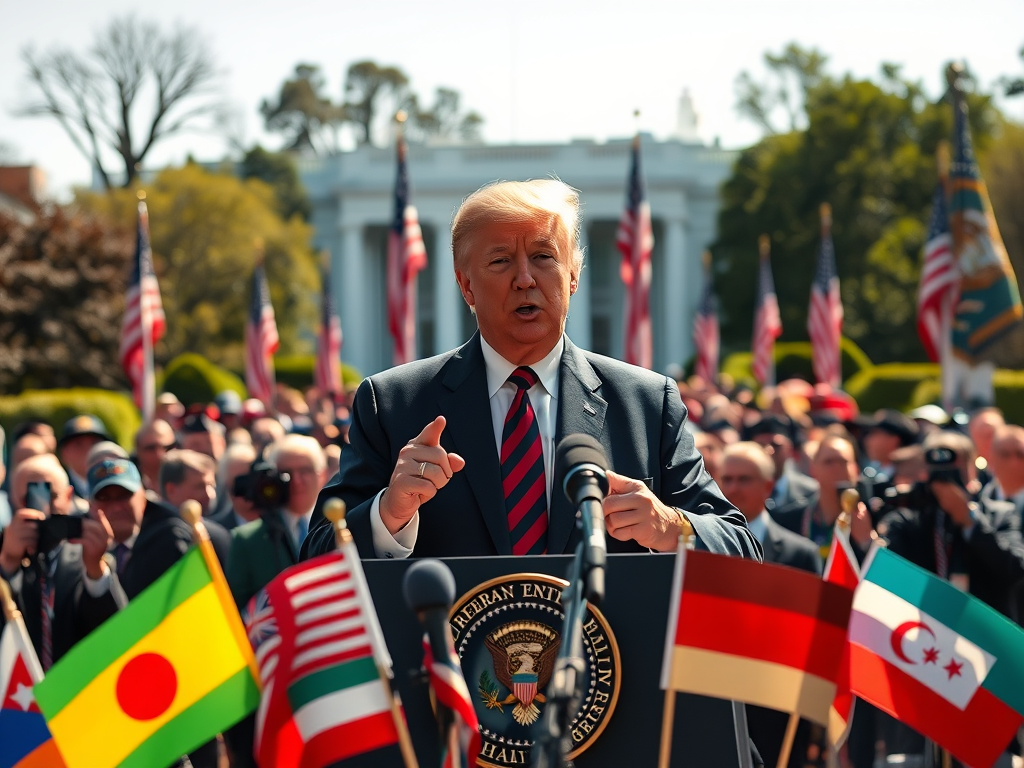
WASHINGTON — President Donald Trump’s sweeping tariff measures, unveiled on what he dubbed “Liberation Day” on April 2, 2025, have jolted global markets and ignited fierce debate over America’s future in a rapidly changing world economy.
In a dramatic departure from decades of trade liberalization, the administration has imposed a 10% universal tariff on virtually all imports into the United States, with additional punitive rates targeting key trading partners. For instance, Chinese goods now face an effective duty of 54%—a rate that combines the new measures with preexisting levies—while countries in the European Union and Taiwan are set to encounter tariffs ranging from 20% to 32%. The policy, according to White House officials, is aimed at rebalancing trade deficits and “making America wealthy again” by forcing other nations to renegotiate longstanding trade practices.
A Bold, Unconventional Approach
At a Rose Garden ceremony on April 2, President Trump characterized the announcement as “one of the most important days in American history.” He asserted that these measures were a direct response to what he described as decades of unfair global trading practices that have left U.S. manufacturers and workers at a disadvantage.
“We have been taken advantage of for too long,” Trump said during his address. “It’s time to level the playing field. If you want your tariff rate to be zero, then build your product here in America.”
Trump’s strategy hinges on two pillars: a baseline 10% tariff on all imports taking effect at 12:01 a.m. ET on April 5, 2025, and a series of “reciprocal tariffs” on roughly 60 of America’s major trading partners, set to begin on April 9. The administration claims that these targeted duties will compel nations to eliminate their own trade barriers, though critics contend the approach is too blunt an instrument.
Domestic and Global Ripples
While supporters argue the tariffs will spur domestic job creation and reinvigorate American industry, economists warn of significant downside risks. Early projections indicate that U.S. households could see annual cost increases of more than $1,000, as higher tariffs push up prices on everyday items—from electronics to groceries. Market volatility has already become palpable; on April 4, U.S. stock indexes recorded some of the steepest declines in recent years, and analysts at Fitch Ratings have warned that the policies could tip multiple countries into recession.
“The tariffs are a game changer, not only for the U.S. economy but for the global economy,” said Olu Sonola, head of U.S. economic research at Fitch Ratings. “Many countries will likely end up in a recession if these policies persist.”
Even within the United States, uncertainty reigns. While the additional tariff revenue—estimated at around $500 billion—may be used to fund tax cuts and stimulate manufacturing, some experts argue that if the funds are instead used for fiscal tightening, the net effect could be a substantial drag on economic growth.
Straining Alliances and Altering Geopolitics
Internationally, the response has been swift and, in some cases, severe. Traditional U.S. allies such as Canada, Mexico, and members of the European Union have either imposed countermeasures or are in the process of negotiating their responses. In Asia, China has retaliated by raising its own tariffs on U.S. exports—though, as Reuters reported, its response has so far been measured, reflecting an effort to avoid provoking a full-scale trade war.
Analysts warn that by broadening the scope of tariffs to include not just adversaries but also key allies like Japan and South Korea, the administration risks isolating the United States at a time when international cooperation is critical. “The fact that Trump is potentially alienating so many U.S. trade partners at the same time weakens the overall impact of our strategy,” said Joe Mazur, a geopolitics analyst at Trivium.
Critics argue that the aggressive tariff campaign may undercut U.S. strategic objectives, particularly with respect to countering China’s growing influence. While the tariffs are ostensibly designed to deter Chinese aggression and protect Taiwan, they might inadvertently drive other nations to align more closely with Beijing. Moreover, cuts in foreign aid and the shuttering of counter-propaganda channels like Radio Free Asia have further eroded America’s soft power.
The Long Road Ahead
As the global economy adjusts to this new reality, the long-term effects of Trump’s tariff policies remain uncertain. While some economists believe that the disruptions could be temporary—provided that negotiations lead to a rollback of the most draconian measures—others caution that the risks of inflation, reduced consumer spending, and even a recession are significant.
“The speed with which these tariffs have been imposed leaves little room for error,” said one market strategist. “If the policy sticks around, we could be looking at a period of significant economic pain for the U.S. and its trading partners.”
For now, all eyes remain on Washington and the negotiations that will determine whether these measures become a lasting fixture of U.S. trade policy or a transient chapter in a rapidly evolving economic landscape.
 Bright Echoes
Leave a comment